
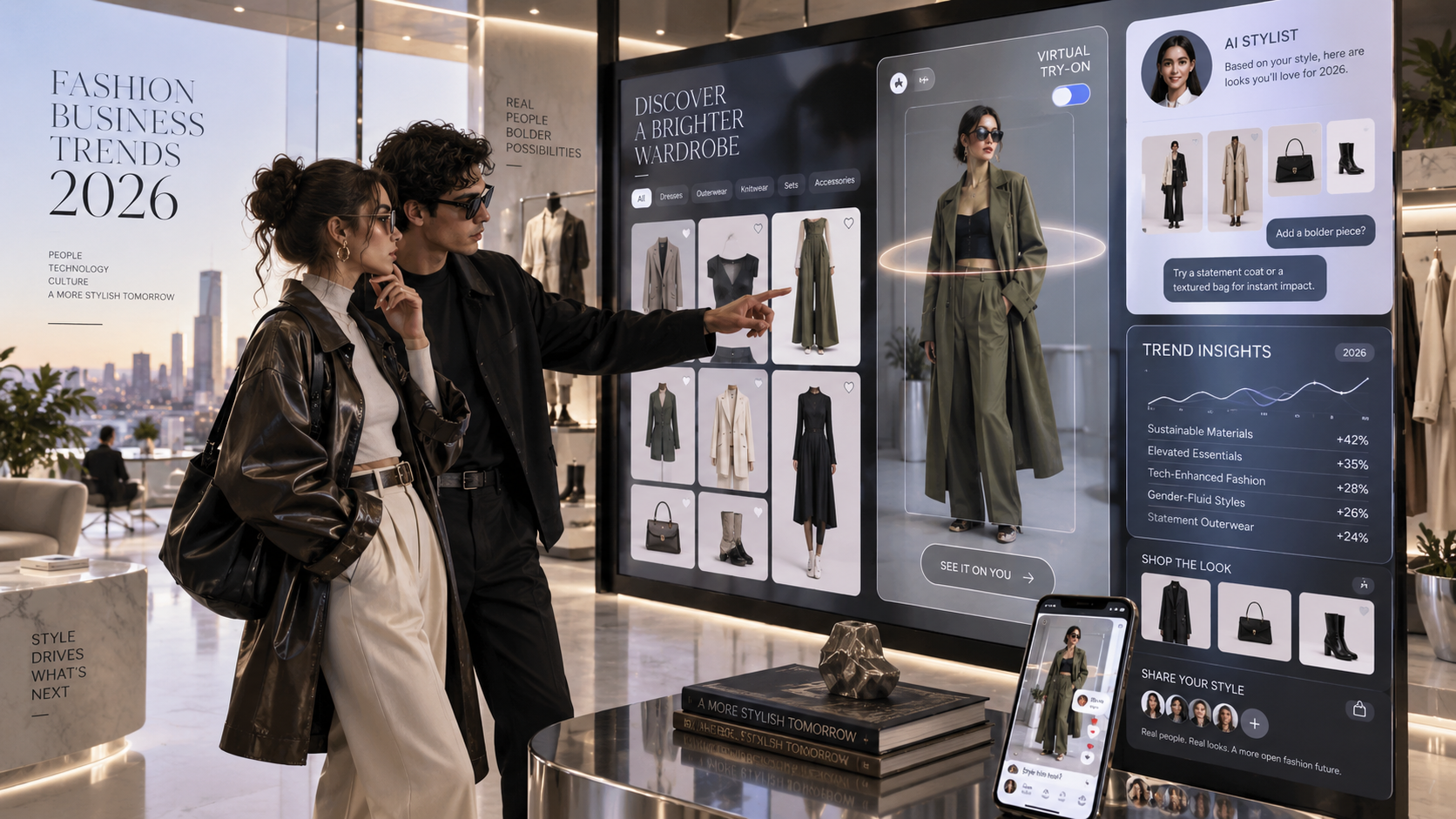
Fashion Is Becoming a Platform Business. AI, Social Commerce and Resale Are Changing How We Discover and Buy Clothes
Fashion in 2026 is no longer changing only on the runway. Some of the biggest shifts are happening behind the scenes — in the platforms, marketplaces and technologies that determine how clothes are discovered, sold, recommended and resold.
One of the most important changes is the rise of the AI shopper.
Consumers are increasingly using AI assistants to find products, compare brands and ask questions such as: “Find me a black leather jacket under £200 that looks similar to this one.” For fashion companies, this creates an entirely new form of competition.
McKinsey and The Business of Fashion argue that brands now need to think beyond traditional SEO. If consumers increasingly discover products through ChatGPT-style assistants and AI search, brands also need to make sure their products can be understood and recommended by those systems. (McKinsey & Company)
This is sometimes being described as generative engine optimisation, or GEO.
Instead of competing only for the first position on Google, fashion companies may increasingly compete to become one of the products an AI assistant recommends.
British retailer ASOS is already treating agentic AI as a structural change rather than another small digital feature. Its technology leadership says the opportunity goes across product discovery, customer experience and internal operations — but warns that companies should invest only where AI produces a meaningful commercial result. (McKinsey & Company)
Another fast-growing part of the fashion platform economy is virtual try-on.
Online fashion has always had one obvious problem: customers cannot see what a garment will actually look like on their own body.
That is beginning to change.
German retailer Breuninger worked with Google Cloud on a system allowing customers to upload a selfie and see themselves wearing selected fashion products. The project moved from experimental testing into a live shopping feature. (Google Cloud)
And this technology is no longer limited to major luxury retailers. Shopify’s app ecosystem now contains hundreds of tools offering AI-powered virtual try-on, size recommendations, 3D viewing and digital fitting-room functions to smaller e-commerce stores. (Shopify App Store)

That could become particularly important because returns remain one of the biggest problems in online fashion. A better idea of fit before purchasing could potentially reduce some unnecessary orders and returns.
At the same time, resale is becoming a serious fashion business model rather than a side market.
Platforms such as Vinted, Depop and The RealReal have helped make secondhand fashion mainstream. According to McKinsey, the secondhand fashion and luxury market is expected to grow two to three times faster than the firsthand market through 2027. (McKinsey & Company)
There is an important reason for this.
Consumers are looking for value as new clothing becomes more expensive, but they also like resale because it gives them access to products that may be rare, discontinued or otherwise difficult to find.
For Gen Z in particular, resale can be both economical and aspirational.
McKinsey’s research found that consumers also use resale platforms to explore brands they may later buy new. That changes the old assumption that secondhand automatically competes with a brand’s primary business. (McKinsey & Company)
The numbers show how powerful the platforms have become.
In 2025, brand- and retailer-operated resale programmes accounted for around 275,000 active online listings, while Depop alone had more than 40 million. (McKinsey & Company)
That leaves fashion brands with an interesting decision.
Do they ignore the resale market and let platforms control it?
Do they partner with an existing marketplace?
Or do they build their own resale ecosystem and make money from the same garment more than once?
Another important development is the move from traditional e-commerce towards conversational shopping.
The standard fashion website still gives customers hundreds or thousands of items to scroll through.
AI could replace part of that experience with conversation.
Instead of manually selecting size, colour, price and category filters, a customer could simply say:
“I need something for a summer wedding in Italy. I don’t want anything sleeveless, my budget is £150 and I want to wear it again.”
The platform could then build a shortlist.
McKinsey identifies this move from search boxes towards agentic product discovery as one of the most significant changes coming to fashion commerce. (McKinsey & Company)
For younger shoppers, fashion discovery is also increasingly happening before they ever reach a retailer’s website.
TikTok, Instagram, creators, resale apps and AI recommendations are all becoming entrances into the shopping journey.
This changes the role of the traditional online store.
A fashion website is no longer necessarily where discovery begins. It may simply be the place where a purchase is completed after a customer has already discovered the product somewhere else.
That makes fashion increasingly a platform business.
A successful brand may need to exist simultaneously inside social platforms, marketplaces, resale systems, AI assistants and its own direct-to-consumer store.
AI is also changing what happens inside fashion businesses.
More than 35% of fashion executives surveyed for The State of Fashion 2026 said their companies were already using generative AI in areas including customer service, image generation, copywriting, consumer search or product discovery. (McKinsey & Company)
The next phase is likely to go beyond content creation.
AI agents could help with merchandising, stock allocation, sales analysis, customer segmentation and forecasting. That means fashion companies may increasingly operate with a mix of creative people, data systems and automated agents.
But there is another trend happening at the same time: consumers are becoming more price-conscious.
McKinsey reports that around 70% of consumers surveyed planned to spend less, while 80% demonstrated some form of value-seeking behaviour such as waiting for sales or comparing retailers. (McKinsey & Company)
That helps explain why resale, affordable luxury and smarter recommendation systems are becoming so important.
Consumers may still want fashion.
They are simply becoming more selective about where they buy it, how much they pay and whether the product feels worth the money.
The fashion business of 2026 therefore looks very different from the simple model of designing a collection, advertising it and selling it through stores.
The emerging model looks more like an ecosystem:
AI helps customers discover products. Social media creates demand. Platforms facilitate transactions. Virtual try-on reduces uncertainty. Resale gives garments a second commercial life.
The next battle in fashion may therefore be about more than who creates the strongest collection.
It may be about who controls the platform through which the customer discovers, experiences and eventually buys it.
Sources: McKinsey & The Business of Fashion • Google Cloud • ASOS • Shopify • The State of Fashion 2026.